Choosing the right hosting plan is one of the first important decisions you need to make when launching a website. A good hosting service helps your website load smoothly, remain accessible to visitors, and handle traffic without unnecessary problems. However, with so many hosting options available, it can be difficult to decide which plan is right for your needs.
Two of the most popular options are shared hosting and VPS hosting. Both can be suitable for different types of websites, but they offer different levels of performance, resources, flexibility, and control.
So, shared hosting vs VPS hosting: which is better for your website? The answer depends on your website's size, expected traffic, budget, and technical requirements.
In this guide, we will explain the differences between shared hosting and VPS hosting, their advantages and disadvantages, and how to choose the right option for your business.
What Is Shared Hosting?
Shared hosting is a web hosting service in which multiple websites use resources from the same physical server. These resources may include processing power, memory, and storage.
It is one of the most affordable hosting options, making it a popular choice for beginners, small businesses, bloggers, and personal websites.
For example, if you want to create a business website to showcase your services, publish blog posts, and receive customer enquiries, shared hosting may provide everything you need to get started.
Most shared hosting plans include a hosting control panel, email accounts, database support, SSL options, and website management tools, depending on the provider and package.
Advantages of Shared Hosting
1. Affordable pricing
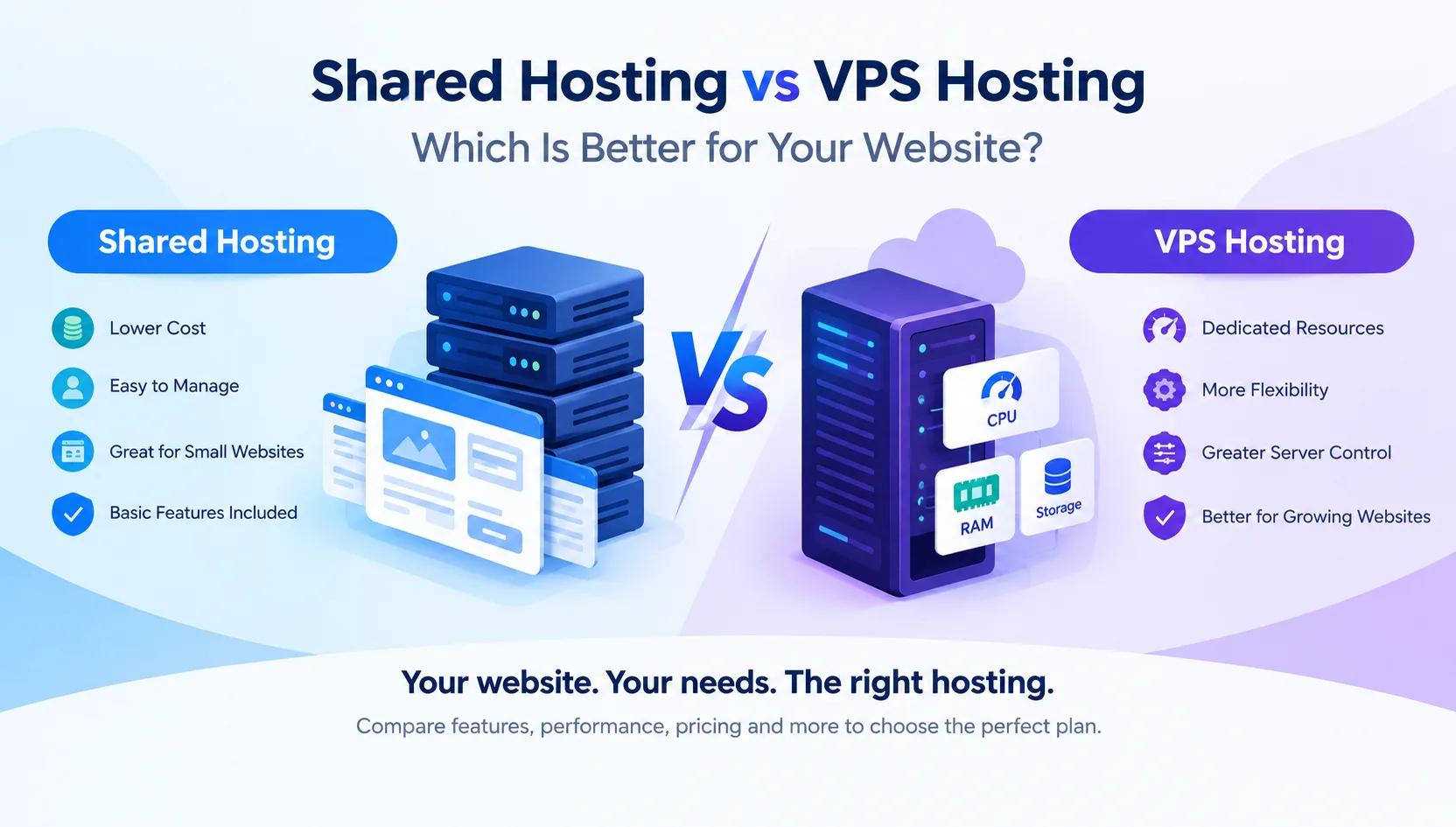
Shared hosting is generally less expensive than VPS hosting because the server's cost is distributed among multiple customers. It is a practical option for people who want to launch a website without spending too much on hosting.
2. Easy to manage
You do not usually need advanced server administration skills. The hosting provider manages the underlying server infrastructure, allowing you to focus on your website.
3. Suitable for small websites
Personal blogs, portfolio websites, local business websites, and new company websites can often run comfortably on shared hosting.
4. Basic hosting features included
Depending on the plan, you may receive a control panel, email services, database access, SSL certificates, backups, and one-click application installation.
Disadvantages of Shared Hosting
Shared hosting also has some limitations.
Shared resources: Your website shares server resources with other websites, so performance can be affected when resources become heavily used.
Limited server control: You generally cannot change all server-level settings or install every software package.
Restricted resource limits: Storage, memory, CPU usage, and other resources depend on your selected plan.
Less suitable for demanding applications: Large websites and resource-intensive applications may eventually need a more powerful hosting environment.
Shared hosting is a good starting point, but it may not be the best long-term choice for every growing website.
What Is VPS Hosting?
VPS stands for Virtual Private Server. VPS hosting uses virtualization technology to divide a physical server into multiple virtual servers.
Each VPS receives an allocated set of resources, such as RAM, CPU capacity, and storage. This gives you a more isolated and configurable environment than traditional shared hosting.
VPS hosting is suitable for growing businesses, high-traffic websites, web applications, online stores, and projects that require more control over their hosting environment.
For example, if your e-commerce website receives increasing orders or your web application needs specific server software, a VPS may offer the flexibility you need.
There are generally two common management options:
Managed VPS hosting: The provider handles agreed server maintenance and management tasks.
Unmanaged VPS hosting: You are responsible for much of the server configuration, maintenance, updates, and security.
Always check what management services are included before purchasing a plan.
Advantages of VPS Hosting
1. Dedicated resource allocation
A VPS has allocated resources, helping provide more predictable performance than a typical shared hosting account. Actual performance still depends on the plan, server configuration, and provider.
2. Greater flexibility
You can usually configure more server settings and install supported software according to your application's requirements.
3. Better suitability for growing websites
VPS hosting can handle workloads that exceed the limits of an entry-level shared hosting plan, provided you choose adequate resources.
4. More server control
Depending on the operating system and plan, you may receive administrative or root access. This is useful for developers and businesses that need greater control.
5. Room for expansion
Many VPS providers allow you to upgrade RAM, CPU, storage, or other resources as your requirements increase. The available upgrade options depend on the provider.
Disadvantages of VPS Hosting
VPS hosting offers more flexibility, but it also comes with responsibilities.
Higher cost: VPS plans generally cost more than entry-level shared hosting.
Technical knowledge may be required: Unmanaged VPS hosting requires familiarity with server administration.
Security responsibilities: Root access gives you more control, but incorrect configuration can create security risks.
Maintenance requirements: Depending on the service, you may need to manage operating system updates, firewalls, software patches, and backups.
If you want VPS performance without managing the server yourself, a managed VPS plan may be worth considering.
Shared Hosting vs VPS Hosting: Key Differences
The main difference between shared hosting and VPS hosting is the level of resource allocation, flexibility, and server control available to you.
| Feature | Shared Hosting | VPS Hosting |
|---|---|---|
| Cost | Usually lower | Usually higher |
| Resources | Shared server environment | Allocated virtual server resources |
| Performance | Suitable for lighter workloads | Better suited to more demanding workloads |
| Traffic handling | Best for modest or predictable traffic | More flexibility for traffic growth |
| Server control | Limited | Greater control |
| Technical skills | Beginner-friendly | Depends on managed or unmanaged service |
| Custom software | More restricted | More configuration options |
| Security | Provider-managed shared environment | Greater isolation, but configuration still matters |
| Scalability | Depends on the hosting plan | Often offers more upgrade flexibility |
| Best for | Blogs and small business websites | Growing websites and applications |
Remember that hosting quality varies between providers. A well-configured shared hosting plan can perform better than an undersized or poorly managed VPS.
Which Hosting Is Better for Website Performance?
Website performance depends on several factors, including server resources, caching, database queries, application code, image sizes, and network quality.
Shared hosting can deliver good performance for small websites that do not require substantial resources. It is often sufficient for a new business website or a blog with moderate traffic.
However, if your website experiences slow loading during busy periods, uses resource-intensive plugins, or runs complex database operations, VPS hosting may provide more room to improve performance.
With a VPS, you can often adjust server settings, configure caching, and allocate resources according to your application's needs.
Before upgrading, check your website's actual bottleneck. Poorly optimized code or oversized images can cause slow loading even on a powerful server.
Shared Hosting vs VPS Hosting for WordPress Websites
Both hosting options can run WordPress websites, but the right choice depends on how you use WordPress.
Shared hosting is often suitable for:
New WordPress blogs
Small business websites
Portfolio websites
Informational websites with moderate traffic
VPS hosting may be more suitable for:
Large WordPress websites
WooCommerce stores with demanding workloads
Membership websites
Websites using resource-intensive plugins
Projects requiring custom server configurations
If you are starting a new WordPress website, shared hosting can help keep costs low. You can consider moving to VPS hosting when your traffic, sales, or resource requirements increase.
Which Is Better for an E-Commerce Website?
An online store needs reliable performance because visitors may browse products, add items to their carts, and complete payments at the same time.
A small store with a limited product catalogue may work well on a suitable shared hosting plan. However, as product listings, traffic, and customer activity increase, resource limitations may become a concern.
VPS hosting can provide more control over server resources, caching, database performance, and application configuration. This can be useful for stores with more demanding workloads.
However, VPS hosting does not automatically guarantee better security or uninterrupted service. You should also consider SSL, regular backups, software updates, payment gateway security, monitoring, and the provider's support quality.
Choose hosting based on your store's actual requirements rather than assuming every online store needs a VPS from day one.
Shared Hosting vs VPS Hosting: Which Is More Secure?
Security is an important consideration for every website, regardless of its size.
In shared hosting, multiple customers use the same physical server infrastructure. Hosting providers generally implement isolation and security controls to protect customer accounts.
VPS hosting offers a more isolated virtual environment, along with greater control over security configurations. However, the level of protection depends on how the server is maintained and configured.
For VPS hosting, important security measures include:
Keeping the operating system and applications updated
Configuring a firewall correctly
Using strong passwords and SSH keys where appropriate
Disabling unnecessary services
Taking regular backups
Monitoring server activity
Limiting administrative access
A poorly maintained VPS can be less secure than a properly managed shared hosting account. Security depends on both the hosting environment and the quality of its management.
Shared Hosting vs VPS Hosting: Which Is More Affordable?
Shared hosting is usually the better option if your primary goal is to launch a website at a low cost.
VPS hosting costs more because it offers allocated resources and greater configuration flexibility. Unmanaged plans may have lower prices than fully managed alternatives, but they require more technical involvement.
When comparing hosting prices, do not look at the monthly charge alone. Check the renewal price, storage type, RAM, CPU allocation, bandwidth policy, backup availability, support coverage, and upgrade costs.
For a small website, paying for VPS resources you do not need may be unnecessary. On the other hand, a growing business could lose valuable time and potential customers if its hosting plan cannot handle its workload.
The best option is the one that provides the resources and reliability your website needs at a reasonable total cost.
When Should You Upgrade from Shared Hosting to VPS Hosting?
You do not need to upgrade simply because your website has been online for a certain number of months. Instead, look for signs that your current hosting plan is no longer meeting your requirements.
Consider VPS hosting when:
Your website regularly reaches CPU, memory, or other hosting limits.
Your website slows down as visitor activity increases.
You run applications that require specific server configurations.
Your online store or business platform has become more resource-intensive.
You need greater control over server settings.
Your current plan cannot provide the resources required for your next stage of growth.
Before migrating, review your website's traffic, resource usage, database performance, and application requirements. Choose a VPS with enough capacity for your current workload and reasonable room for growth.
A planned migration with tested backups and a suitable maintenance window can help reduce disruption.
How to Choose the Right Hosting Provider
Whether you choose shared hosting or VPS hosting, the hosting provider matters.
Before purchasing a plan, consider the following points:
Performance: Look for suitable CPU and RAM allocations, fast storage, and reliable network connectivity.
Uptime: Review the provider's uptime commitment and how it handles service interruptions.
Security: Check for SSL support, backup options, account isolation, and security maintenance.
Customer support: Make sure support is available through channels that work for you and covers the issues you may encounter.
Scalability: Confirm whether you can upgrade your resources without unnecessary complications.
Pricing: Compare introductory prices with renewal costs and check for additional fees.
Management: For VPS hosting, understand whether server administration, monitoring, backups, and updates are included.
A reliable provider should make it easier to manage your website as your business grows.
Why Choose Bindass Host?
If you are looking for web hosting for a new website or a growing online business, Bindass Host offers a place to explore hosting options suited to different requirements.
Before selecting a plan, consider the resources your website needs, the level of server control you want, and the support you expect from your hosting provider.
You can visit Bindass Host to explore the available hosting services and choose an option that fits your website and budget.
Whether you are launching your first business website or planning to move a growing project to a VPS, start with your current requirements and select a plan that leaves reasonable room for future growth.
Frequently Asked Questions (FAQs)
1. What is the main difference between shared hosting and VPS hosting?
Shared hosting places multiple websites in a shared hosting environment, while VPS hosting provides a separate virtual server with allocated resources. VPS hosting generally offers greater control and flexibility.
2. Is shared hosting good for beginners?
Yes. Shared hosting is usually beginner-friendly, affordable, and suitable for small websites, personal blogs, and new business websites.
3. Is VPS hosting faster than shared hosting?
VPS hosting can deliver better and more predictable performance for demanding websites because it provides allocated resources. However, actual speed depends on server configuration, website optimization, and the hosting provider.
4. Can I upgrade from shared hosting to VPS hosting later?
Yes. Many hosting providers support migration from shared hosting to VPS hosting. The process may involve moving website files, databases, email accounts, and DNS settings.
5. Is VPS hosting suitable for high-traffic websites?
It can be, provided the VPS has enough resources and is configured properly. Very large websites may require a larger VPS, dedicated servers, or a scalable cloud infrastructure.
6. Which is better for a small business website: shared hosting or VPS hosting?
Shared hosting is often sufficient for a small business website with moderate traffic and standard functionality. VPS hosting may be a better choice when the website requires additional resources or custom server configurations.
7. Does VPS hosting include a control panel?
Some VPS plans include a control panel, while others offer it as an optional paid service. Check whether the plan includes cPanel, another control panel, or command-line administration.
8. Is VPS hosting worth the extra cost?
VPS hosting can be worth the extra cost when your website needs more resources, greater control, or specific server configurations. For a small website with modest requirements, shared hosting may offer better value.
Final Verdict: Shared Hosting or VPS Hosting?
There is no single hosting plan that is best for every website.
Choose shared hosting if you are launching a blog, personal website, portfolio, or small business website and want an affordable, easy-to-manage solution.
Choose VPS hosting if your website needs more resources, greater server control, custom configurations, or additional flexibility as your business grows.
The smartest approach is to start with a plan that matches your current requirements and upgrade when your website genuinely needs more resources.
Compare the features, support, security, and total cost before making your decision. The right hosting service can give your website a dependable foundation and help your business grow with confidence.
Ready to launch your website? Visit Bindass Host to explore your hosting options.
Shared hosting vs VPS hosting difference
Which is better shared hosting or VPS hosting
Shared hosting vs VPS hosting for beginners
Best hosting for small business websites
VPS hosting for high-traffic websites
Shared hosting advantages and disadvantages
VPS hosting advantages and disadvantages
Affordable web hosting
WordPress shared hosting vs VPS hosting
Best VPS hosting for growing websites
Need help choosing a plan?
Our team will recommend the right hosting for your site — no jargon, no pressure.