Best Web Hosting in India 2026: How to Choose the Right Plan
Choosing web hosting sounds simple until you start comparing plans. One company offers a low introductory price, another advertises unlimited bandwidth, and a third promises faster performance with NVMe storage. With so many options available, it is easy to pay for features you do not need or choose a plan that struggles when your website starts growing.
The right hosting plan can make managing your website much easier. Your pages should load smoothly, your website should remain accessible, and your visitors should feel confident sharing their details or placing an order.
Whether you are launching your first blog, building a business website, running an online store, or managing websites for clients, this guide will help you understand how to choose the best web hosting in India in 2026.
What Is Web Hosting and Why Does It Matter?
Web hosting is a service that stores your website's files, images, databases and other resources on a server connected to the internet. When someone enters your domain name into a browser, the hosting server delivers the content needed to display your website.
Think of your domain name as your business address and web hosting as the place where your business operates. Both are important, but they serve different purposes.
A good hosting service helps you:
Keep your website accessible to visitors.
Load pages efficiently on desktop and mobile devices.
Protect website files and customer information.
Manage databases, email accounts and website applications.
Handle increasing traffic as your business grows.
Recover your website when something goes wrong.
For Indian businesses, hosting selection also involves practical considerations such as server location, support availability, payment methods and the actual cost after the introductory offer ends.
Types of Web Hosting Available in India
Before choosing a provider, understand the main hosting options. The best choice depends on your website's size, expected traffic, technical requirements and budget.

1. Shared Hosting
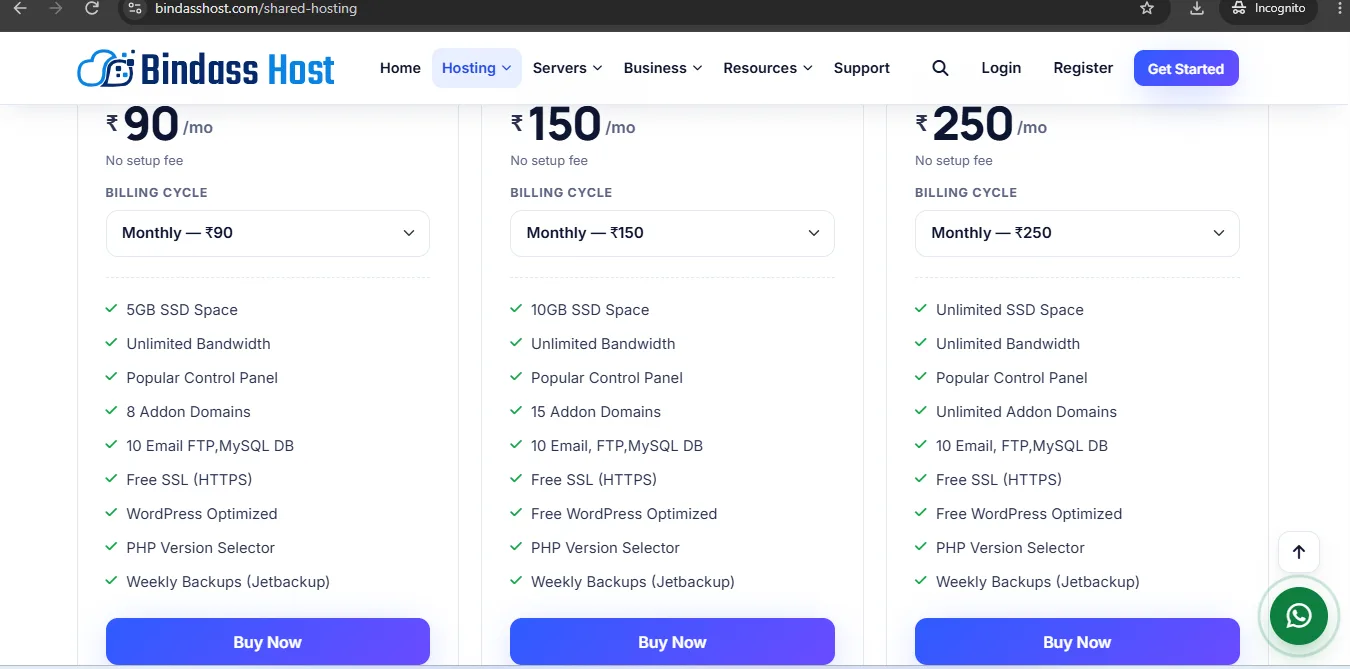
Shared hosting allows multiple websites to use resources on the same server. The hosting company manages much of the server infrastructure, so beginners can focus on their websites rather than server administration.
Best for: Personal blogs, portfolios, small business websites and new projects.
2. WordPress Hosting
WordPress hosting is designed to make running a WordPress website easier. Depending on the plan, it may include automatic installation, caching, backups, updates and WordPress-specific support.
Best for: Bloggers, content publishers, agencies and businesses using WordPress.

3. VPS Hosting
Virtual Private Server (VPS) hosting provides an isolated virtual server environment with allocated resources. Depending on the package, you may also receive root access and greater control over server configuration.
Best for: Growing websites, web applications, multiple client projects and custom software.

4. Cloud Hosting
Cloud hosting uses cloud infrastructure to run websites and applications. Some platforms offer flexible scaling, managed services and improved options for handling changing workloads.
Best for: Growing businesses, busy websites, applications and projects with unpredictable traffic.

5. Dedicated Server Hosting
Dedicated hosting gives you an entire physical server instead of sharing its computing resources with unrelated customers. It offers substantial control but usually requires a larger budget and more technical knowledge.
Best for: Resource-intensive applications, large businesses and specialised workloads.
Shared Hosting vs VPS Hosting vs Cloud Hosting
If you are confused about which hosting type to select, start with this comparison.
Feature | Shared hosting | VPS hosting | Cloud hosting |
|---|---|---|---|
Initial cost | Usually low | Moderate | Varies by configuration |
Server control | Limited | High, depending on plan | Depends on platform |
Technical knowledge | Basic | Moderate to advanced | Basic to advanced |
Resource isolation | Limited | Virtual resource isolation | Depends on architecture |
Scaling options | Plan-dependent | Upgrade or resize | Often flexible |
Ideal use | Small websites | Growing applications | Variable or larger workloads |
Practical advice: If you are launching a simple business website, shared hosting may be sufficient. If your website runs custom PHP software, multiple applications or resource-intensive database operations, a VPS may offer more flexibility. Cloud hosting is worth considering when your workload needs flexible capacity or additional infrastructure options.
You do not need the most powerful server from day one. Choose a plan that meets your present needs and offers a sensible upgrade path.
10 Things to Check Before Buying Web Hosting in India
The cheapest plan is not always the best value. Review these factors before making a decision.
1. Server Location
If most of your visitors are in India, a data centre in India may help reduce network latency. However, the actual speed also depends on server performance, network routing, caching, website optimisation and the visitor's internet connection.
Ask the provider where your website will be hosted. Do not assume that an Indian company automatically uses servers located in India.
2. SSD or NVMe Storage
Storage technology affects how quickly a server can access website files and databases. SSD and NVMe storage can provide faster access than traditional hard drives, although the overall result also depends on CPU performance, memory, software configuration and server load.
NVMe storage is worth considering for websites that handle frequent database queries or numerous files. Still, a well-configured SSD hosting plan can be perfectly adequate for a small website.
3. Uptime and Reliability
Uptime refers to the time your website remains available to visitors.
A provider advertising 99.9% uptime offers a useful reference point, but you should also read its uptime guarantee and service agreement.
For perspective, 99.9% uptime permits approximately 8 hours and 46 minutes of downtime over a 365-day year. Actual outages may be distributed differently, and an advertised guarantee does not necessarily mean every incident is compensated.
Look for transparent monitoring, clear service terms and a reliable support process.
4. Free SSL Certificate
SSL/TLS encryption protects information exchanged between your website and visitors' browsers. It is particularly important for login pages, enquiry forms and online transactions.
Check whether the plan includes SSL certificates, automatic renewal and support for HTTPS configuration.
5. Backup and Restore Options
A backup is only useful if you can restore it when necessary.
Before purchasing a hosting plan, check:
How frequently backups are created.
How many days of backups are retained.
Whether database backups are included.
Whether restoration is self-service or requires support.
Whether backups are stored separately from the primary server.
For business websites and online stores, keep an independent backup wherever practical. Do not rely on a hosting provider as your only copy of important data.
6. Customer Support
When your website stops working, waiting several hours for a response can cost you leads or sales.
Check the provider's support hours, available channels and escalation process. If you use CodeIgniter, Laravel, WordPress or another specific platform, confirm that the support team can assist with the relevant hosting environment.
Remember that hosting support may not include custom coding, debugging third-party applications or fixing every website error.
7. Control Panel and Server Management
A control panel makes routine hosting tasks easier. Depending on your needs, you might look for:
cPanel or another supported hosting panel.
Domain and DNS management.
Database and file management.
Email account management.
SSL configuration.
Application and PHP version controls.
If you choose a self-managed VPS, confirm whether the plan includes a control panel. Many VPS plans require you to configure the operating system, firewall, web server, updates and backups yourself.
8. Security Features
Basic security should be part of your hosting decision.
Look for firewall options, malware scanning, account isolation, security updates, DDoS protection where appropriate, and clear incident-response procedures.
You should also use strong passwords, multi-factor authentication where available, least-privilege access and regularly updated website software.
No hosting plan can guarantee complete protection against every attack.
9. Renewal Price and Additional Charges
This is one of the most important factors when comparing affordable web hosting in India.
An introductory offer may be available only when you pay for a longer term. Renewal pricing, taxes, domain renewals, email services, backup add-ons and migration fees can change the total cost.
Before checkout, compare the amount payable today with the amount payable at renewal. Also check the refund policy and any conditions attached to promotional pricing.
10. Upgrade and Migration Options
Your hosting requirements may change as your website grows. A good provider should offer a practical way to upgrade resources or migrate to a more suitable plan.
Ask whether the provider offers migration assistance, whether migration is free for your selected plan, and whether there are limits on the number or size of websites moved.
How Much Does Web Hosting Cost in India in 2026?
Web hosting prices vary by provider, configuration, billing term and promotional offer. The following ranges are illustrative budgeting estimates, not verified quotations from any specific company.
Hosting type | Indicative budget | Suitable for |
|---|---|---|
Shared hosting | ₹1,200–₹6,000 per year | Small websites and blogs |
Managed WordPress hosting | ₹3,000–₹12,000 per year | WordPress websites needing extra convenience |
VPS hosting | ₹6,000–₹40,000+ per year | Growing websites and applications |
Cloud hosting | ₹8,000–₹1,00,000+ per year | Flexible or resource-intensive workloads |
Dedicated servers | ₹60,000+ per year | Larger or specialised workloads |
Actual costs can fall outside these ranges, particularly for high-resource servers and managed services. Taxes and optional services may be charged separately.
When comparing plans, calculate the full cost for the period you intend to use the service. A lower monthly equivalent may require a much larger upfront payment.
How to Choose the Right Hosting Plan for Your Business
Here are some common situations and the hosting options worth considering.
For a new blog or personal website
For a small business website
For an e-commerce website
For developers and web agencies
For hosting resellers
Is Cheap Web Hosting in India Worth It?
Affordable hosting can be a good decision when you are starting out. You do not need an expensive server to publish a portfolio, a basic company website or a new blog.
Problems arise when you choose a plan without checking its limitations.
For example, a low-cost package might be perfectly adequate for a five-page company website but unsuitable for a busy online store. Another package might offer plenty of storage but restrict CPU usage or simultaneous processes.
Before buying cheap web hosting in India, check the actual resource limits, renewal price, backup policy, support quality and migration options.
The goal is not to buy the cheapest plan. It is to find the lowest-cost plan that meets your requirements reliably.
Why Website Speed Matters for SEO
Hosting is one part of website performance, and performance is one part of the wider search optimisation process.
A slow website can frustrate visitors, reduce engagement and make important actions harder to complete. Search engines also use page experience signals, including Core Web Vitals, as part of their broader ranking systems.
To improve website performance:
Choose hosting appropriate for your website's workload.
Enable suitable server-side caching.
Compress and resize images.
Use a content delivery network (CDN) when appropriate.
Reduce unnecessary scripts and plugins.
Optimise database queries.
Monitor Core Web Vitals and real-world page performance.
Moving to a more expensive server will not automatically solve a poorly optimised website. Diagnose the actual bottleneck before upgrading.
Common Web Hosting Mistakes to Avoid
Even an experienced website owner can overlook important details when comparing hosting plans.
Choosing on price alone: A cheap introductory offer may cost much more at renewal.
Buying excessive resources: A new website rarely needs a high-end dedicated server.
Ignoring backups: Check that restoration is practical, not just that backups are advertised.
Assuming all unlimited offers are unlimited: Providers may still apply fair-use policies and resource limits.
Overlooking technical requirements: Confirm support for your framework, PHP version, database and required extensions.
Not securing the hosting account: Use strong passwords and restrict account access.
Ignoring migration terms: Moving a website can involve extra costs or technical work.
Expecting hosting to fix every SEO issue: Content quality, technical SEO, internal linking and user experience also matter.
Frequently Asked Questions (FAQs)
1. Which is the best web hosting in India in 2026?
The best web hosting provider depends on your website, budget, technical skills and expected traffic. Shared hosting is a sensible starting point for many small websites, managed WordPress hosting suits WordPress users who want convenience, and VPS or cloud hosting may be more appropriate for growing applications.
Compare current prices, renewal terms, support, server locations and backup policies before deciding.
2. Which hosting is best for beginners in India?
Shared hosting or managed WordPress hosting is generally suitable for beginners. These options reduce the amount of server administration required and make it easier to get a website online.
3. How much does website hosting cost in India?
Entry-level shared hosting may cost a few hundred rupees per month at standardised annual-equivalent rates, while VPS, cloud and dedicated servers can cost substantially more. Actual prices depend on the provider, subscription period, resources, taxes and renewal terms.
4. Is VPS hosting better than shared hosting?
VPS hosting usually provides more control and isolated virtual resources, making it useful for applications with specific technical requirements. Shared hosting is typically easier to manage and more affordable for smaller websites. Neither option is automatically better for every use case.
5. Is NVMe hosting worth it?
NVMe storage can improve storage access performance, particularly for database-intensive workloads. However, CPU, RAM, software configuration, caching and network quality also affect the overall speed of your website.
6. Do I need a server located in India?
If most of your visitors are in India, an Indian data centre can reduce network latency. It is still important to consider the provider's infrastructure, network routing, CDN configuration and website optimisation.
7. Can I change my hosting plan later?
Yes, many providers offer upgrades and migration options. Before purchasing, confirm whether you can increase resources easily and whether the provider offers migration assistance.
8. What is the difference between web hosting and a domain name?
A domain name is your website's address, while web hosting stores and serves your website's files and application. You can register a domain with one company and host your website with another.
9. Is free web hosting suitable for a business website?
Free hosting may work for experiments or learning, but it can have restrictions on resources, support, branding, security and reliability. For a business website that generates leads or sales, a suitable paid plan is generally a more practical choice.
10. What should I check before purchasing a hosting plan?
Review renewal prices, server location, storage, CPU and RAM limits, SSL, backup frequency, restoration options, support availability, refund terms and the ability to upgrade or migrate.
Final Verdict: Choose Hosting That Fits Your Needs
The best web hosting in India in 2026 is not necessarily the provider with the biggest discount or the longest feature list. It is the service that runs your website reliably, provides the resources you need and fits your budget over the long term.
For a new website, start with an affordable shared or managed WordPress plan. For a growing business or custom application, evaluate VPS and cloud hosting. If you run a resource-intensive platform, consider whether a dedicated server is justified.
Take a few minutes to check the renewal price, backup arrangements, server location and support policy before making your decision. These details can make a much bigger difference than a promotional headline.
Ready to launch your website? Compare hosting plans carefully, choose the resources you need today, and make sure your provider can support your next stage of growth.
Need help choosing a plan?
Our team will recommend the right hosting for your site — no jargon, no pressure.